
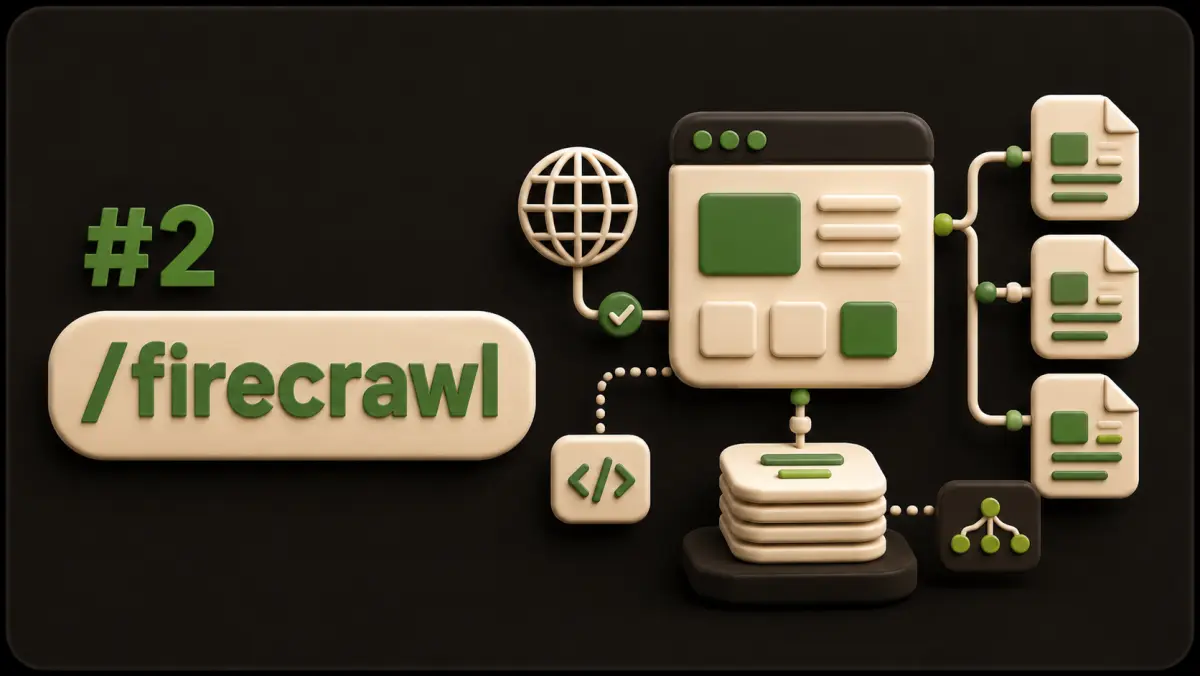
Scrape websites for AI agent research when the answer sits on a page nobody has opened this quarter. Changelogs move. Pricing tables change. A competitor rewrites their feature list every sprint. Your agent answers from weights trained months ago, sounds certain, and misses the sentence that mattered.
I hand teams this skill second, right after source reading, because it covers the other half of "where does truth live." Tip 1 opens the library on disk. This one opens the live web.
Why web research needs a skill
Product work leans on the public web more than engineers admit. Support quotes docs. Sales asks whether a rival shipped SSO. Design needs the exact constraint from a browser API page. Leave those lookups outside the agent loop and a human becomes the scraper. Let them in without structure and the agent drowns the session in HTML.
A job-named skill fixes both. Call it research-live-web-evidence rather than firecrawl-utils, following the convention in name AI agent skills after the job. The description states when to scrape and when to stop.
Pick the surface that matches the question
Firecrawl's guide on choosing the data extractor draws the line for you. One known URL takes /scrape, optionally with JSON mode, and it stays cheaper and synchronous. Discovery across sites takes /agent, which their docs reserve for cases where you do not know the URLs or need navigation across the web.
Three defaults cover most product questions:
- A changelog paragraph on a known docs URL takes
/scrape. - "Which rivals list SCIM on the mid tier" takes
/agentwith a tight prompt and a schema. - Fifty known partner pages take batched
/scrape, never a crawl of the open internet.
Agents reach for the biggest tool available. Your skill has to refuse that. Start narrow, escalate when the narrow path fails.
Write the skill as a contract
1. Restate the decision this research has to inform. 2. List allowed domains, or write "public web, no authenticated app surfaces." 3. Choose /scrape or /agent and give a one-line reason. 4. Extract only the fields in the schema or bullet list. 5. Return citations as URL plus quoted span plus retrieval date. 6. Block product code edits until those citations exist.
Ungated research turns into decoration that nobody reads twice. Gated research shows up in pull requests.
Keep raw pages out of the prompt
Scraped markdown beats raw HTML and still runs too large for casual pasting. Write outputs to a research folder such as site/tips/_research/ or a private .firecrawl/ directory. The agent reads the saved file, summarizes it, and keeps the path in the answer. You reopen the artifact next quarter, and the context window survives the session.
Tip 3 covers the other half of that budget, where you make the agent talk less with caveman. Compression trims the narration around citations. Saving the artifact still matters.
Schemas beat vibes
Structured comparison needs a schema. Pricing tiers, feature flags, support channels, last-updated dates. A schema turns a marketing page into rows you can diff in three months. Free-form summaries work for a one-time read and fail for recurring competitive tracking.
A workable Agent prompt reads like this: "Find public pricing pages for tools A, B, and C. Return plan name, monthly price, and SSO availability. Prefer primary vendor pages over blogs." Seed it with homepages when you already know them. The Firecrawl Agent product page shows the same prompt-to-dataset shape.
The citation bar
A useful research answer names the page, quotes the line behind the claim, and dates the retrieval. "According to the web" fails that bar. "Per https://example.com/pricing retrieved 2026-07-26: Enterprise includes SSO" passes it. Reviewers click. The next agent re-scrapes when the decision still matters.
Prefer primary pages over roundup blogs, and say so when a blog is the only source available. Inventing URLs is forbidden. A failed scrape gets reported, not paraphrased from memory.
Governance that does not kill speed
Scraping trips legal and security alarms when you aim it at private apps or paywalled data. Default the skill to public documentation, marketing pages, and open changelogs. Route anything behind a login through a human. Log the URLs each research note touched.
Credits are the other axis. Firecrawl documents the cost difference between scrape and agent runs, so put a ceiling on Agent jobs and teach the agent to stop after a fixed number of sources unless someone raises the budget.
When scraping is the wrong move
Query the database when the answer lives in your data. Use opensrc when the answer lives in a dependency. Book fifteen minutes when the answer lives in a teammate's head. Scraping earns its place on public, changing, page-shaped truth.
Skip it when the page is already in the thread. Re-scraping the same URL five times in an hour points at a bug in the skill body.
A worked example
A founder asked whether three rivals bundled SSO on the mid tier. The agent without scraping produced a confident matrix from memory, and two cells were wrong. We reran it as a Firecrawl Agent prompt with a schema for plan name, monthly price, and SSO boolean, seeded with the three marketing domains. The structured result matched the live pages, and sales reused the artifact that afternoon.
The value was the repeatable extract with URLs attached. Next quarter the same skill runs again and diffs the rows.
Ship the habit this week
Install the Firecrawl CLI or SDK your agents already call and scrape one known docs URL by hand. Write the job-named skill with the contract above. Run three real questions from your backlog, keep the two scrapes that changed a decision, and note the credit spend. Open source context lives on github.com/firecrawl/firecrawl and the docs root.
Tip 1 covered read dependency source code with opensrc for installed libraries. Keep both skills with separate triggers so the agent picks instead of guessing. A zod coercion bug goes to opensrc. A vendor status claim goes to Firecrawl. An architecture decision that needs both runs both and cites both.
If you want that kit dropped into Cursor or Claude Code for your product org, book a call.
Sources
- Firecrawl docs
- Firecrawl Agent
- Choosing the data extractor
- firecrawl/firecrawl on GitHub
- Firecrawl Agent product page
Need a research skill kit wired for your stack
Book a callFAQ
Should every research question use Firecrawl Agent?
No. Firecrawl's guide says JSON mode on /scrape stays cheaper and synchronous for a single known URL. Reserve /agent for discovery when the URLs are unknown or the job spans many sites.
How do I keep scrapes out of the hot context window?
Write results to disk under a project research folder, then have the agent summarize with links. Tip 3 covers compressing the narration that remains.
What belongs in the skill description?
The job: gather evidence from live web pages for product decisions. Then the triggers, such as pricing checks, changelog reads, and competitor feature claims.
Can agents scrape authenticated product surfaces?
Only with explicit credentials and an allowlist your security team approved. Default research skills stay on public docs and marketing pages.